Christian Slater is almost unrecognisable as Bob Maconel, a man who plans on going postal, and seems to have been planning it for some time. Every day he imagines himself blowing up the building and every day he loads his revolver with the intent to go through and every day he returns home and his goldfish calls him a chicken.
One day, as he's loading his gun, his coworker goes postal ahead of him, and by gunning him down, Bob is suddenly held up as a hero by the people who's names were all but on the bullets with which he saved their lives.
It's a hell of a premise. It would probably make a hell of a black comedy. Unfortunately He Was a Quiet Man is an incredibly bleak and serious drama. It makes occasional hints at it's comic potential, like the business with the fish, but they seem to simply be further elements of the torturous nature of Bob's world.
Much of the film is concerned with his relationship with Elisha Cuthbert's character, a corporate climber who was left paraplegic in the aftermath of the shooting. Caring for the former object of his office crush becomes the one true ray of sun in Bob's grey life, but even this eventually becomes further fodder for his cavernous insecurities.
It's just relentless, even after he's crossed that crucial threshold, been the man at the edge fighting back, which makes films such as Office Space and American Beauty so delightful, he's still trapped in a grim, meaningless existence, merely a few floors higher up, and it's not long before he's back to his cubical with a gun in his hand; His self destruction only prolonged.
At around 80 minutes longer than it should have been, I'm not sure what the film's point was. Unless it was that railing against the system is a futile maneuver, in which case it's not one I cared to hear.
Saturday, 11 June 2011
Thursday, 9 June 2011
The Fighter
During one of the films titular fights the commentator comments that "You couldn't make it up". And it turns out that they didn't. I only discovered this fact during the final credits, but the film is based on real life events. Micky and Dicky are real people and there is indeed a HBO documentary about life on crack in Lowell.
Not knowing was probably a blessing, as I've mentioned before I often find biographies unsettling, and that was avoided here, but I think knowing that it was adhering, however roughly to actual events would have helped me accept a plot that felt really rather contrived.
You see, boxing films are generally not about boxing. Oh sure, someone is likely to punch someone else at some point, but more often than not such blows represent the fury of some other conflict within the characters life. This is why many film based boxers are Rocky types who can take on serious trauma and still stand up. We love a guy with heart. A character with character. But they're often a little more subtle than that, less straightforward. Not so with The Fighter. The relationship is pretty much one to one. It's used explicitly as a metaphor illustrating the ways in which he differs from his brother and his success in the ring isn't related to his determination or fitness, but how happy he happens to be at the time and how he feels about his brother. A little bit of Amy Adams and the guy is all but invincible. Which I guess is understandable.
It does have certain merits. Despite it's aggravatingly blatant subtext it's a decent if predictable story and one I can't help but think would have made for a smashing documentary. The in film documentary itself is an interesting device, used to frame certain events and it's showing is perhaps the pivotal moment of the plot, during which the change in demeanour Bale's character undergoes was compelling enough to make me reevaluate his presence in what is a very strange role. Almost unrecognisably wiry and addled, and sporting a bizarre accent, he's both the films comic relief and essentially one of it's antagonists. Distinctive no doubt, but a bit on the weird side.
Ultimately I found the film shallow. Despite an apparent attempt to engage with powerful drama, it makes few demands on the viewer, to back that drama up with anything other than the usual sporting cliches.
Not knowing was probably a blessing, as I've mentioned before I often find biographies unsettling, and that was avoided here, but I think knowing that it was adhering, however roughly to actual events would have helped me accept a plot that felt really rather contrived.
You see, boxing films are generally not about boxing. Oh sure, someone is likely to punch someone else at some point, but more often than not such blows represent the fury of some other conflict within the characters life. This is why many film based boxers are Rocky types who can take on serious trauma and still stand up. We love a guy with heart. A character with character. But they're often a little more subtle than that, less straightforward. Not so with The Fighter. The relationship is pretty much one to one. It's used explicitly as a metaphor illustrating the ways in which he differs from his brother and his success in the ring isn't related to his determination or fitness, but how happy he happens to be at the time and how he feels about his brother. A little bit of Amy Adams and the guy is all but invincible. Which I guess is understandable.
It does have certain merits. Despite it's aggravatingly blatant subtext it's a decent if predictable story and one I can't help but think would have made for a smashing documentary. The in film documentary itself is an interesting device, used to frame certain events and it's showing is perhaps the pivotal moment of the plot, during which the change in demeanour Bale's character undergoes was compelling enough to make me reevaluate his presence in what is a very strange role. Almost unrecognisably wiry and addled, and sporting a bizarre accent, he's both the films comic relief and essentially one of it's antagonists. Distinctive no doubt, but a bit on the weird side.
Ultimately I found the film shallow. Despite an apparent attempt to engage with powerful drama, it makes few demands on the viewer, to back that drama up with anything other than the usual sporting cliches.
One Hour Photo
Robin Williams has always been good at using his own persona, challenging our associations for effect. He leveraged his reputation for irrepressibly happy roles to create hugely sympathetic, often heartbreakingly tragic characters, such as in The Fisher King and the episode of Homicide: Life on the Street in which he guest starred. He's been in a fair number of duffers too, but you can't win them all.
So successful was the shift that he became typecast in this new part and is now slightly notorious for crying a lot. But, once again, using this image of him we had, he's moved into doing villains, carrying with him the sympathy and creating an uncomfortable contrast. Comedians often make good monsters (John Lithgow, Billy Connolly, John Goodman, even Michael Palin. But then Jim Carrey did play The Riddler that one time, so maybe it's just coincidence), but Williams carries with him that extra edge from his dramatic roles.
However, I'm not sure I would actually describe Sy the Photo Guy as a villain. He's several foodstuffs short of an outdoors feast, for certain, but he's almost too sympathetic to be seen as entirely dangerous or detrimental. I found myself actually rooting for the guy as he stalked a family. I didn't exactly want him to succeed, whatever that would have meant, but I didn't want to see him fail or break. The families characters are too thin for you to generate tremendous concern for their well being, and while what he is doing would be pretty damn disturbing in real life, the film has an element of fantasy to it. It's beautifully shot, and does a wonderful job of contrasting the vibrant world he craves versus the dour one he inhabits. But as pretty as this all is, it created a magical dream like edge, an absence of reality, within which a character who acts in much the manner of a fairy god mother, a guardian angel, who secretly looks out for them, made a strange sort of sense.
Indeed, there are only a small handful of scenes that fall outside and thus break this idea. If it were not for these and a soundtrack that is working the sinister angles throughout, I'm pretty sure it would work as a comedy. A train of thought helped onto the tracks by the presence of "Bill Lumbergh" as his boss.
While a bit of an issue if one wants to think of the film as the thriller as which it's billed, I'm glad (if a bit uneasy) that I saw it this way. I think the sympathy for the lonely creep was vital, if I'd viewed his as a wholly negative presence I think it would have been very dull and straightforward. Just sinister and little more. The conflict between a desire to see him achieve a positive outcome and the danger he definitely presents with a capacity to overreact made the movie, made it complex and it's use of context fascinating.
So successful was the shift that he became typecast in this new part and is now slightly notorious for crying a lot. But, once again, using this image of him we had, he's moved into doing villains, carrying with him the sympathy and creating an uncomfortable contrast. Comedians often make good monsters (John Lithgow, Billy Connolly, John Goodman, even Michael Palin. But then Jim Carrey did play The Riddler that one time, so maybe it's just coincidence), but Williams carries with him that extra edge from his dramatic roles.
However, I'm not sure I would actually describe Sy the Photo Guy as a villain. He's several foodstuffs short of an outdoors feast, for certain, but he's almost too sympathetic to be seen as entirely dangerous or detrimental. I found myself actually rooting for the guy as he stalked a family. I didn't exactly want him to succeed, whatever that would have meant, but I didn't want to see him fail or break. The families characters are too thin for you to generate tremendous concern for their well being, and while what he is doing would be pretty damn disturbing in real life, the film has an element of fantasy to it. It's beautifully shot, and does a wonderful job of contrasting the vibrant world he craves versus the dour one he inhabits. But as pretty as this all is, it created a magical dream like edge, an absence of reality, within which a character who acts in much the manner of a fairy god mother, a guardian angel, who secretly looks out for them, made a strange sort of sense.
Indeed, there are only a small handful of scenes that fall outside and thus break this idea. If it were not for these and a soundtrack that is working the sinister angles throughout, I'm pretty sure it would work as a comedy. A train of thought helped onto the tracks by the presence of "Bill Lumbergh" as his boss.
While a bit of an issue if one wants to think of the film as the thriller as which it's billed, I'm glad (if a bit uneasy) that I saw it this way. I think the sympathy for the lonely creep was vital, if I'd viewed his as a wholly negative presence I think it would have been very dull and straightforward. Just sinister and little more. The conflict between a desire to see him achieve a positive outcome and the danger he definitely presents with a capacity to overreact made the movie, made it complex and it's use of context fascinating.
Wednesday, 8 June 2011
Frost/Nixon
Yet more biographical film making and more of the uneasy feeling that the truth of events have been changed or massaged to meet an external dramatic structure. Did Frost really stand alone, like Cnut in front of the waves of financial crisis? Did he really transform into a true journalist in their darkest hour? Where the interviews even taken in that poetic order? Are these even the words that were spoken?
I've read since that are some sizable concessions to fiction, and I think that knowledge would have placed me in a better position to have seen it from. To have accepted it's level of authenticity, as it was uncertainly that left me unsettled. Which is a shame because it's pretty successful tension; It's all very satisfying, and more to do with what the interviews meant than their precise method of execution.
Framed as a duel, a prize fight between an experienced political heavyweight and an unqualified entertainer from Blighty. A classical underdog story. There's even a training montage as Frost undertakes serious preparation for the final recording. They manage to convey the significance of the real life revelations and use them as Frost's knock out blow. True or not, it's an ingenious piece of narrative.
And one surprisingly sympathetic to Nixon, who I'm more used to seeing as a corrupt monstrosity that set fire to the American dream. While certainly presented as a wily individual, as one would expect of such a high profile political operator, we're left with the sense that he strongly believed in the institution and system, and felt his mistakes were in failing to adequately protect it.
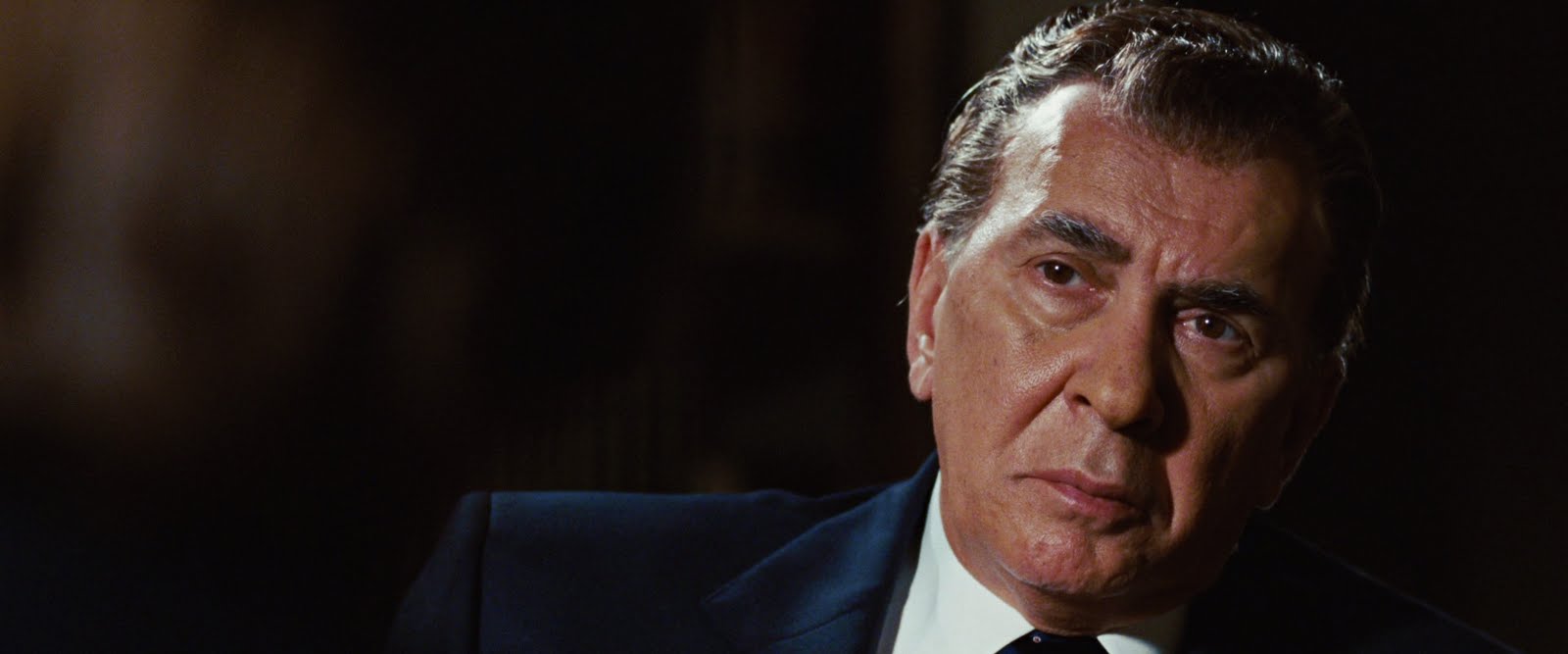
I found Sheen a little strange as Frost, but oddly intense is rather his calling card. Langella on the other hand is enormously compelling, stealing the show outright. Not looking a good deal like Nixon, at first it was hard to place him in the role, but by the end he had transformed my very image of the man so that it was more in line with his portrayal. Intricate and convincing, it really is a remarkable piece of acting. And here I am remarking upon it.
An excellent piece of storytelling. Funny and dramatic in turn, it manages to pack wide significance, tension and even excitement into what boils down to two guys having a chat.
I've read since that are some sizable concessions to fiction, and I think that knowledge would have placed me in a better position to have seen it from. To have accepted it's level of authenticity, as it was uncertainly that left me unsettled. Which is a shame because it's pretty successful tension; It's all very satisfying, and more to do with what the interviews meant than their precise method of execution.
Framed as a duel, a prize fight between an experienced political heavyweight and an unqualified entertainer from Blighty. A classical underdog story. There's even a training montage as Frost undertakes serious preparation for the final recording. They manage to convey the significance of the real life revelations and use them as Frost's knock out blow. True or not, it's an ingenious piece of narrative.
And one surprisingly sympathetic to Nixon, who I'm more used to seeing as a corrupt monstrosity that set fire to the American dream. While certainly presented as a wily individual, as one would expect of such a high profile political operator, we're left with the sense that he strongly believed in the institution and system, and felt his mistakes were in failing to adequately protect it.
I found Sheen a little strange as Frost, but oddly intense is rather his calling card. Langella on the other hand is enormously compelling, stealing the show outright. Not looking a good deal like Nixon, at first it was hard to place him in the role, but by the end he had transformed my very image of the man so that it was more in line with his portrayal. Intricate and convincing, it really is a remarkable piece of acting. And here I am remarking upon it.
An excellent piece of storytelling. Funny and dramatic in turn, it manages to pack wide significance, tension and even excitement into what boils down to two guys having a chat.
Tuesday, 7 June 2011
Son of Rambow
I imagine like many who come to watch this film, there is much in it that echoes the childhood I pretend I had. Entire worlds erected in the imagination, fueled (rather than hindered which is no doubt closer to the truth) by things seen through the television, warm summer days spent flirting with blunt force trauma in the name of homage.
There are a couple of weighty barriers to capturing the essence of childhood on film, the essential wonder of it, chief among them the general standard of acting among the young. In this regard The Son of Rambow rather comes up trumps, having not one but two apparently perfectly cast kids in the leading roles. Will is an impossibly naive child with a vivid imagination who's only exposure to television is First Blood while his friend and opposite Lee Carter is a street wise delinquent with an excellent mouth.
Set somewhere in the eighties, the two set out to make Will's Rambo charged dreams a reality with a video camera borrowed from Lees older asshole brother. Their movie within a movie (in which the two manage to act acting terribly) becomes increasing elaborate, involving more and more of the student body and driving a wedge into their fledgling friendship.
It's all enormously sweet. Childish but in an entirely positive way, naive and slightly magical. Their friendship is bizarre but somehow entirely believable. It's surprisingly intricate with various subplots and tangents, and it manages to find pay offs in all of them. The conclusion to the french exchange student story is particularly wonderful. While it does has it's moments, usually from the mouth of Carter, it's not the funniest of comedies, but I'm not sure that was ever it's intent. It's subtlety charming and disarmingly obscure.
While I'm sure I would have still believed it to be strong without, it really appealed to several of my senses for nostalgia. Being of a similar age at a similar time, and having spent much of my youth toying with camera equipment and/or daydreaming in fields, it was terribly pleasing to discover a film made by people who clearly shared my wistful affections for such things.
There are a couple of weighty barriers to capturing the essence of childhood on film, the essential wonder of it, chief among them the general standard of acting among the young. In this regard The Son of Rambow rather comes up trumps, having not one but two apparently perfectly cast kids in the leading roles. Will is an impossibly naive child with a vivid imagination who's only exposure to television is First Blood while his friend and opposite Lee Carter is a street wise delinquent with an excellent mouth.
Set somewhere in the eighties, the two set out to make Will's Rambo charged dreams a reality with a video camera borrowed from Lees older asshole brother. Their movie within a movie (in which the two manage to act acting terribly) becomes increasing elaborate, involving more and more of the student body and driving a wedge into their fledgling friendship.
It's all enormously sweet. Childish but in an entirely positive way, naive and slightly magical. Their friendship is bizarre but somehow entirely believable. It's surprisingly intricate with various subplots and tangents, and it manages to find pay offs in all of them. The conclusion to the french exchange student story is particularly wonderful. While it does has it's moments, usually from the mouth of Carter, it's not the funniest of comedies, but I'm not sure that was ever it's intent. It's subtlety charming and disarmingly obscure.
While I'm sure I would have still believed it to be strong without, it really appealed to several of my senses for nostalgia. Being of a similar age at a similar time, and having spent much of my youth toying with camera equipment and/or daydreaming in fields, it was terribly pleasing to discover a film made by people who clearly shared my wistful affections for such things.
Monday, 6 June 2011
Fallen
I'm surprised we didn't see more of this sort of thing in the wake of X-Files. In fact, wasn't this idea an episode of X-Files already? I imagine it worked better there. Fallen lets it's premise get away from it a little
Bringing an interesting riff on the murderer mythology, the film's antagonist is a killer who cannot die, a literal force of evil, a parasitic entity that can take over anybody, can be anyone. He/it's a full realisation of the social fear of the serial killer: The monster who looks just like us. There's an awful lot to work with there, but it's not worked especially well here.
Firstly it gets ahead of itself. It gives the game away pretty much right out of the gate, we're ahead of Denzel for a good hour or so, which is just frustrating. Yes, the films marketing probably covered it in order to get you to your local multiplex, but the discovery, the detection is clearly an important aspect in what should be a supernatural detective story. Once the beings nature is revealed to our beleaguered detective, in an admittedly memorable scene in which it sings to him, all elements of police procedure are forgot in favour of a reasonably generic horror plot. There's some nonsense about demons and the end of days and by which point I was passed caring.
There are a handful of scenes that stuck, the cast is surprisingly strong and while some fairly weighty actors phone a lot of the performance in, they do occasionally come alive. Usually when they had a bit of demon inside of them, but ultimately they took an idea that perfectly resonated with serial killer fiction and then proceeded to remove as much of the serial killer aspect as they could. So much more could have been done with the idea and the actors. For shame.
Bringing an interesting riff on the murderer mythology, the film's antagonist is a killer who cannot die, a literal force of evil, a parasitic entity that can take over anybody, can be anyone. He/it's a full realisation of the social fear of the serial killer: The monster who looks just like us. There's an awful lot to work with there, but it's not worked especially well here.
Firstly it gets ahead of itself. It gives the game away pretty much right out of the gate, we're ahead of Denzel for a good hour or so, which is just frustrating. Yes, the films marketing probably covered it in order to get you to your local multiplex, but the discovery, the detection is clearly an important aspect in what should be a supernatural detective story. Once the beings nature is revealed to our beleaguered detective, in an admittedly memorable scene in which it sings to him, all elements of police procedure are forgot in favour of a reasonably generic horror plot. There's some nonsense about demons and the end of days and by which point I was passed caring.
There are a handful of scenes that stuck, the cast is surprisingly strong and while some fairly weighty actors phone a lot of the performance in, they do occasionally come alive. Usually when they had a bit of demon inside of them, but ultimately they took an idea that perfectly resonated with serial killer fiction and then proceeded to remove as much of the serial killer aspect as they could. So much more could have been done with the idea and the actors. For shame.
Superbad
As filmic territory goes the coming of age movie has to be among it's most widely traveled. Seemingly every generation robs it's characters, themes, tropes and often full on plot from the previous ones and attempts to stamp something new upon them. And I suppose as each fresh generation finds such a film at a time when they are emotionally placed to find particular relevance, each new wave has it's own purpose. But from a wider perspective, as in one no longer of that age, it can't help but be unfavourably compared to whatever happened to catch me when I was.
Which is probably a shame, as Superbad is I believe a pretty strong example. While it has some of it's own ideas, mostly it deals in the familiar, but covers a lot more ground than usual and does so with a good deal of style and charm. It's a more interesting and indirect "get the girl" story than the typical teenage affair (such as boy meets girl, girl has jock boyfriend, boy enters some sporting event in order to impress girl, boy turns into werewolf, boy humiliates/mauls jock boyfriend and gets girl), and unusually it splits the lead between the typical "good but naive" and "fun but reckless" roles, each with their own oblique romance arc.
Michael Cera is, I believe an acquired taste, but having recently watched my way through the excellent Arrested Development I've become quite a fan of his awkward teen schtick, it's timing is excellent. One wonders how long that will continue to be welcome, but for now it's generally pleasing. Jonah Hill I find slightly disturbing with his glassy eyed stare, but he pinned down the sympathetic asshole role rather well. The films other plot involves the extreme geek and some bizarre cops, which runs out of steam pretty quickly but does have by far the best dialogue and is the most unusual element, almost belonging to a whole other movie.
The problem I found with the whole thing however, is that I didn't find any of it remotely funny. A lot of what I assume were jokes just fell horribly flat, it barely even registered as amusing and left me trying to deal with it as some sort of teenage drama. "Not my cup of tea" seems a particularly poor explanation as for why, but that is seemingly all I have. It kind of works straight, as a decent balance of the new and familiar, covering, as I say, a lot of the ground with aplomb, but I felt it's main thrust just passed me by.
Which is probably a shame, as Superbad is I believe a pretty strong example. While it has some of it's own ideas, mostly it deals in the familiar, but covers a lot more ground than usual and does so with a good deal of style and charm. It's a more interesting and indirect "get the girl" story than the typical teenage affair (such as boy meets girl, girl has jock boyfriend, boy enters some sporting event in order to impress girl, boy turns into werewolf, boy humiliates/mauls jock boyfriend and gets girl), and unusually it splits the lead between the typical "good but naive" and "fun but reckless" roles, each with their own oblique romance arc.
Michael Cera is, I believe an acquired taste, but having recently watched my way through the excellent Arrested Development I've become quite a fan of his awkward teen schtick, it's timing is excellent. One wonders how long that will continue to be welcome, but for now it's generally pleasing. Jonah Hill I find slightly disturbing with his glassy eyed stare, but he pinned down the sympathetic asshole role rather well. The films other plot involves the extreme geek and some bizarre cops, which runs out of steam pretty quickly but does have by far the best dialogue and is the most unusual element, almost belonging to a whole other movie.
The problem I found with the whole thing however, is that I didn't find any of it remotely funny. A lot of what I assume were jokes just fell horribly flat, it barely even registered as amusing and left me trying to deal with it as some sort of teenage drama. "Not my cup of tea" seems a particularly poor explanation as for why, but that is seemingly all I have. It kind of works straight, as a decent balance of the new and familiar, covering, as I say, a lot of the ground with aplomb, but I felt it's main thrust just passed me by.
Sunday, 5 June 2011
Limitless
Limitless has a really wonderful concept. The idea of a chemical shortcut to ones own potential is tremendously appealing. The problem is that once the film was done I didn't feel it had said anything to further the idea or explore it's consequences. As if it had been so impressed with it's own single good idea that it had decided it was enough and handed in the script early.
One would assume it would be about the dangers of human beings with such powers, or the value of the journey to their discovery over merely the destination, but all of the dangers it presents are artificial, they are created by the situation and not the potential itself. The withdrawal issues involved with the drugs aren't analogous with failed potential, they merely exist to apply narrative tension.
A spoiler here, but it's hard to conclude my frustrated musings without it: At the end, he wins. There is no Pyrrhic victory or Faustian deal, he just carries on as if the previous hour or so have meant nothing. He solves all of his problems and lives happily ever after. There are some big problems with this. Firstly it's ignoring the fact that he has changed to such an extent he is a different person, his former life had to cease, but even worse it is saying that there is no value in the process of meeting ones potential, that it is the goal that is important, how it is achieved is inconsequential. The moral of the story is that the drug is pretty damn awesome, and I felt this missed the point entirely. He and we do not learn any kind of lesson, nothing is said about the nature of human potential itself, it's values or it's dangers, and while Bradley Cooper presents a character who's charismatic and sympathetic enough that we want to see them succeed, it needed to be in a way that found worth in who he was, and not in what the drug had made him.
I feel it had the wrong end of the stick when it came to it's essential science fiction element. It introduces it not to explore it's effect, but merely to provide a background to a separate plot. And while there definitely is interest in a super human who's power is his mind, it very much could have covered all of this ground without compromising on this part. It failed to live up to it's own potential. It was limited.
One would assume it would be about the dangers of human beings with such powers, or the value of the journey to their discovery over merely the destination, but all of the dangers it presents are artificial, they are created by the situation and not the potential itself. The withdrawal issues involved with the drugs aren't analogous with failed potential, they merely exist to apply narrative tension.
A spoiler here, but it's hard to conclude my frustrated musings without it: At the end, he wins. There is no Pyrrhic victory or Faustian deal, he just carries on as if the previous hour or so have meant nothing. He solves all of his problems and lives happily ever after. There are some big problems with this. Firstly it's ignoring the fact that he has changed to such an extent he is a different person, his former life had to cease, but even worse it is saying that there is no value in the process of meeting ones potential, that it is the goal that is important, how it is achieved is inconsequential. The moral of the story is that the drug is pretty damn awesome, and I felt this missed the point entirely. He and we do not learn any kind of lesson, nothing is said about the nature of human potential itself, it's values or it's dangers, and while Bradley Cooper presents a character who's charismatic and sympathetic enough that we want to see them succeed, it needed to be in a way that found worth in who he was, and not in what the drug had made him.
I feel it had the wrong end of the stick when it came to it's essential science fiction element. It introduces it not to explore it's effect, but merely to provide a background to a separate plot. And while there definitely is interest in a super human who's power is his mind, it very much could have covered all of this ground without compromising on this part. It failed to live up to it's own potential. It was limited.
Friday, 3 June 2011
Minority Report
Hollywood has a strange relationship with science fiction, especially when it comes to the higher budget end of the market. It has a tendency to treat it as the selling point, the focus of the trailer, and a method of getting bums upon seats. Maybe it's aliens or maybe it's time travel, maybe the world ended and some overpriced monkey gets to remake Shane with laser cannons, but it's often unimportant, the general idea is to get the concept out of the way as soon as it can so it can go back to being a generic actioner with a thin coating of sci fi trappings.
Minority Report looks like such a movie. It's a little too glossy, the trailers are full of expensive looking action and of course it stars one Tom Cruise, who has founded half a career and probably a string of mansions on the basis of disposable big budget popcorn fodder.
But it's not. It's all a cunning disguise. It is packed with sci fi, it's brimming with the stuff. It throws away ideas that might have been the entire premise of a lesser movie. It's not especially "hard" or deep, it's still something of a chase movie as opposed to exploring the moral implications of punishing crimes that have been predicted, but it's clearly had a good hard think about how technology will affect certain elements of society and has sprinkled it's innovative thoughts lovingly throughout. And few are placed incidentally. The futurism is the very driving force, it's narrative, events and action are all determined by or in reaction to it's fantastic elements. The plot is nicely complex, as one would hope from a plot revolving around predetermination, and while there is one major element that can be surmised by anyone familiar with Columbo, there are some decent surprises along the way.
Cruise himself seems a little misplaced, I believe a less established star might have been able to explore the character more rather than doing his usual thing, but ultimately it is not to any great detriment, and his presence probably helped with the funding so I can't complain too loudly. There are also a couple of leaps in logic within, but the film had built up adequate goodwill for me to consciously ignore them.
Essentially the film is how blockbuster science fiction should be done, but so rarely is. It manages to strike a strong balance between it's intelligence and action without letting either down, you don't have to pay tremendous attention to understand the flow, but are rewarded if you do. It's also always good to see a future in which there are jetpacks.
Minority Report looks like such a movie. It's a little too glossy, the trailers are full of expensive looking action and of course it stars one Tom Cruise, who has founded half a career and probably a string of mansions on the basis of disposable big budget popcorn fodder.
But it's not. It's all a cunning disguise. It is packed with sci fi, it's brimming with the stuff. It throws away ideas that might have been the entire premise of a lesser movie. It's not especially "hard" or deep, it's still something of a chase movie as opposed to exploring the moral implications of punishing crimes that have been predicted, but it's clearly had a good hard think about how technology will affect certain elements of society and has sprinkled it's innovative thoughts lovingly throughout. And few are placed incidentally. The futurism is the very driving force, it's narrative, events and action are all determined by or in reaction to it's fantastic elements. The plot is nicely complex, as one would hope from a plot revolving around predetermination, and while there is one major element that can be surmised by anyone familiar with Columbo, there are some decent surprises along the way.
Cruise himself seems a little misplaced, I believe a less established star might have been able to explore the character more rather than doing his usual thing, but ultimately it is not to any great detriment, and his presence probably helped with the funding so I can't complain too loudly. There are also a couple of leaps in logic within, but the film had built up adequate goodwill for me to consciously ignore them.
Essentially the film is how blockbuster science fiction should be done, but so rarely is. It manages to strike a strong balance between it's intelligence and action without letting either down, you don't have to pay tremendous attention to understand the flow, but are rewarded if you do. It's also always good to see a future in which there are jetpacks.
Thursday, 2 June 2011
The Princess and The Frog
I have to admit it's good to see the Mouse House back in the business of traditional animation, even if I'm a little long in the tooth to really appreciate it (and it's probably not all that traditional). It's pretty classic Disney: princesses and dresses, love through adversity and rags to riches, toe tapping musical numbers and wish fulfillment, talking animals, slightly offensive racial stereotypes and a lightly laboured moral message.
I was a little shaky on what the moral actually was, mind. To work hard at your dreams, but not too hard, to wish, but not too much. That even if you fail you can always to marry into royalty, threaten your landlord with giant reptiles and hope to come out on top when involved in some other suckers magical schemes. Heartwarming stuff.
It's essentially all a little light, but then it's clearly not aimed at hardened cynical film snobs such as myself. It's almost certainly doing it's job by being bright and breezy. There were a couple of nice touches to the usual formula, such as a leading lady who isn't an active damsel, the suprising decision they both make at the end (even if the consequences do not bare thinking about) and the dialogue is often strong, but I was a little surprised at how reserved it all seemed.
I would assume if their intent was to return to the heady days of Lion King and Aladdin, classics of my own personal youth, they would aim to storm barns and grandstand just a little. It all looks good, but rarely sparkles, the music is all strong (I see the hand of Randy Newman at hard at work), but never outstanding, there isn't a specific song you come out half humming or a character who's an instant icon. There is little in there that could be condemned, but I'm uncertain it will single-handedly revive the sleeping genre as one might wish.
I was a little shaky on what the moral actually was, mind. To work hard at your dreams, but not too hard, to wish, but not too much. That even if you fail you can always to marry into royalty, threaten your landlord with giant reptiles and hope to come out on top when involved in some other suckers magical schemes. Heartwarming stuff.
It's essentially all a little light, but then it's clearly not aimed at hardened cynical film snobs such as myself. It's almost certainly doing it's job by being bright and breezy. There were a couple of nice touches to the usual formula, such as a leading lady who isn't an active damsel, the suprising decision they both make at the end (even if the consequences do not bare thinking about) and the dialogue is often strong, but I was a little surprised at how reserved it all seemed.
I would assume if their intent was to return to the heady days of Lion King and Aladdin, classics of my own personal youth, they would aim to storm barns and grandstand just a little. It all looks good, but rarely sparkles, the music is all strong (I see the hand of Randy Newman at hard at work), but never outstanding, there isn't a specific song you come out half humming or a character who's an instant icon. There is little in there that could be condemned, but I'm uncertain it will single-handedly revive the sleeping genre as one might wish.
Wednesday, 1 June 2011
I Am Legend
The film has essentially a single sizable problem, and while it has a small handful of other issues, I feel they largely stem from the central one.
You see, it has monsters in it.
And I know, I know, it's a monster/zombie type apocalypse, it probably needs some monster/zombie types in there somewhere, and this is true, it's important to establish why he is afraid of what squats so menacingly in the dark. The issue here is that that presence is horribly bungled.
The first time we see them is really effective. A blink and you'll miss it shot of bizarre humanoid figures in the gloom. It's solid horror and powerfully gets across the both peril and the characters palpable fear. Every instance from that point is a slow slide from engrossing melancholy science fiction into a mediocre monster movie.
They quickly stop being a lurking presence as they're constantly shown full on in all their dated CGI glory. They're weird, inhuman things, gangly, detached and alien, which diminishes one of the more poignant elements, that these are the people the protagonist failed to save, as they're no longer really recognisable as human beings. Often the less a monster is used the more powerful it's effect upon the viewer and by the end of the picture these freaky jawed bald chaps are used all the damn time.
Which is a shame, because as I say it had been building a thoughtful genre story. The last man after the fall has been territory widely traveled, and vast swathes of it influenced by the novel upon which this film was based, so you would hope it had gotten that bit down if nothing else, and I felt it had. The first half of the film is fascinating and eerie documentation of his existence in the wreck of New York, his connection to the events that cause it and his lonely decent into lunacy. Will Smith, proving he can hold a screen on his own, plays a character who isn't explored in all that much detail, but gets across large waves of despair and hopelessness as he seeks human contact with inanimate objects and a dog he thinks is people.
And then, in a final touch before it descends, it's suggested that the creatures are more than simple beasts, an element well worth exploring, but one put aside in favour of some good old fashion computer graphics. He's given a women and child to protect because how else would we know it's horror and he finds a last minute cure, mainly to the hopelessness that has thus far driven the movie and manages to leave a bad taste in the mouth on the way out.
But I'd be lying if I said there wasn't any value to it. Indeed, as monster movie schlock goes you could do far worse, it's just that I find the shift from potent sci fi to cheap graveyard smash to be deeply dissatisfying. Potential was squandered in the making of this movie, which always riles me something rotten.
You see, it has monsters in it.
And I know, I know, it's a monster/zombie type apocalypse, it probably needs some monster/zombie types in there somewhere, and this is true, it's important to establish why he is afraid of what squats so menacingly in the dark. The issue here is that that presence is horribly bungled.
The first time we see them is really effective. A blink and you'll miss it shot of bizarre humanoid figures in the gloom. It's solid horror and powerfully gets across the both peril and the characters palpable fear. Every instance from that point is a slow slide from engrossing melancholy science fiction into a mediocre monster movie.
They quickly stop being a lurking presence as they're constantly shown full on in all their dated CGI glory. They're weird, inhuman things, gangly, detached and alien, which diminishes one of the more poignant elements, that these are the people the protagonist failed to save, as they're no longer really recognisable as human beings. Often the less a monster is used the more powerful it's effect upon the viewer and by the end of the picture these freaky jawed bald chaps are used all the damn time.
Which is a shame, because as I say it had been building a thoughtful genre story. The last man after the fall has been territory widely traveled, and vast swathes of it influenced by the novel upon which this film was based, so you would hope it had gotten that bit down if nothing else, and I felt it had. The first half of the film is fascinating and eerie documentation of his existence in the wreck of New York, his connection to the events that cause it and his lonely decent into lunacy. Will Smith, proving he can hold a screen on his own, plays a character who isn't explored in all that much detail, but gets across large waves of despair and hopelessness as he seeks human contact with inanimate objects and a dog he thinks is people.
And then, in a final touch before it descends, it's suggested that the creatures are more than simple beasts, an element well worth exploring, but one put aside in favour of some good old fashion computer graphics. He's given a women and child to protect because how else would we know it's horror and he finds a last minute cure, mainly to the hopelessness that has thus far driven the movie and manages to leave a bad taste in the mouth on the way out.
But I'd be lying if I said there wasn't any value to it. Indeed, as monster movie schlock goes you could do far worse, it's just that I find the shift from potent sci fi to cheap graveyard smash to be deeply dissatisfying. Potential was squandered in the making of this movie, which always riles me something rotten.
Sunday, 29 May 2011
La Haine
La Haine is about a lot of things. Racial segregation, cultural malaise, the frustrations of poverty and youth, to name but a few. But really, what it's mostly about is three guys hanging about the place, not really doing a lot.
There are many scenes meant to portray the relationship of the characters and those in their situation with various other elements of society, such as the police and higher culture, but most are intended to establish that these are kids doing what kids will so often do: kill time.
I have to confess I found this effort to portray profound boredom, well, kinda boring. There are large sections that seemed to add very little, and while there is an interesting undertone to the whole thing, they still could have been removed with little consequence other than clawing back precious minutes of my life I could have squandered elsewhere.
The undertone involves a gun and a self fulfilling prophecy. From the moment the weapon is brought forth we're aware of where the film must head, which makes the entire picture a rising tone towards the inevitable gunfire. It's subtly done with the presence of arms effecting every scene in a variety of ways.
Unfortunately even this interesting element wasn't enough to keep me involved. I'm disappointed in myself as there is much to be said for the film, as indeed it has a lot to say, and is perhaps the best handling of juvenile ennui I can think of, but I still found myself just waiting for it to end.
Maybe I felt it didn't explore it's points once made. Maybe I should have watched it years ago when my friend used to rave of it's quality and I would have been better placed to relate to it's tale of disquiet youth. Maybe I've cultivated a distaste for french cinema after being unwillingly subjected to a number of obtuse examples in the name of education. Maybe it was the language gap, I've never had a great relationship with subtitles as I deeply value the construction and rhythm of words spoken out loud for the sake of performance, a matter that merely knowing what has been said simply doesn't replicate.
Maybe it's all of the above, but whatever the reason, and despite a sense that it is objectively a good film, it failed to entertain and engage me. Or I failed to be entertained and become engaged with it. One of the two.
There are many scenes meant to portray the relationship of the characters and those in their situation with various other elements of society, such as the police and higher culture, but most are intended to establish that these are kids doing what kids will so often do: kill time.
I have to confess I found this effort to portray profound boredom, well, kinda boring. There are large sections that seemed to add very little, and while there is an interesting undertone to the whole thing, they still could have been removed with little consequence other than clawing back precious minutes of my life I could have squandered elsewhere.
The undertone involves a gun and a self fulfilling prophecy. From the moment the weapon is brought forth we're aware of where the film must head, which makes the entire picture a rising tone towards the inevitable gunfire. It's subtly done with the presence of arms effecting every scene in a variety of ways.
Unfortunately even this interesting element wasn't enough to keep me involved. I'm disappointed in myself as there is much to be said for the film, as indeed it has a lot to say, and is perhaps the best handling of juvenile ennui I can think of, but I still found myself just waiting for it to end.
Maybe I felt it didn't explore it's points once made. Maybe I should have watched it years ago when my friend used to rave of it's quality and I would have been better placed to relate to it's tale of disquiet youth. Maybe I've cultivated a distaste for french cinema after being unwillingly subjected to a number of obtuse examples in the name of education. Maybe it was the language gap, I've never had a great relationship with subtitles as I deeply value the construction and rhythm of words spoken out loud for the sake of performance, a matter that merely knowing what has been said simply doesn't replicate.
Maybe it's all of the above, but whatever the reason, and despite a sense that it is objectively a good film, it failed to entertain and engage me. Or I failed to be entertained and become engaged with it. One of the two.
Saturday, 28 May 2011
Hunger
I mentioned before that my picture of prisons has been somewhat skewed by popular presentation. In much the same fashion I have become really rather resilient to prison dramas ability to shock, coming to consider largely inhuman conditions "the norm" for such things. Which is why I was deeply surprised at just how god damn nasty Hunger makes the conditions suffered by those in Maze Prison appear.
Split into three distinct sections, Hunger chronicles events immediately prior to the death of Bobby Sands during a hunger strike in 1981.
The first details the protest before the decision to go ahead with the not eating scheme, the "no wash protest". With next to no dialogue, it follows a new inmate to the prison and one of it's guards as they both go about the business of surviving the ordeal. And Christ on a bike is it bad in there. Beatings and humiliation are a regular occurrences. The prisoners, naked to a man, squat in featureless cells smearing their own poop across the walls and peeing under the door while horror after fresh horror is revealed in grim silence.
The middle section, the only real dialogue in the film happens to be dialogue in it's entirely. Shot in one long half hour take, with a couple of angles at the end, it shows a conversation between Sands himself and priest, where he outlines and also strengthens himself to what he feels must now be done. I found the this section the most interesting. It's complex, believable and passionate. The simple presentation letting the actors and script ably carry the weight.
The third, again, mostly devoid of speech, covers his physical deterioration. While lacking the threatening and oppressive nature of the first section (as well as the whole shit-up-the-walls business) it again reveals a fresh hell as it artfully conveys the pain he accepted. Less memorable than the first, indeed it's rather drawn out, which I suppose the nature of his death demanded.
The film takes no stance on the moralities involved, it doesn't pick sides. Or at least I believe it was trying to avoid doing so, I have an almost Pavlovian disapproval of anything Margaret Thatcher says, but the film is not to know this. I don't believe it was even really about the cause for which they suffered, rather the suffering in itself and the determination of these people. While I'm quite sure life in the Maze wouldn't have been some summer camp with their compliance, the fact that they chose many of the hardships they endured left an indelible impression of relentless men.
With little in the way of plot or character and a higher human feces quota than any other film I can name it's not by any means an easy watch, but it has an incredible eye for the imagery and is strangely compelling as it paints it's bleak picture.
Split into three distinct sections, Hunger chronicles events immediately prior to the death of Bobby Sands during a hunger strike in 1981.
The first details the protest before the decision to go ahead with the not eating scheme, the "no wash protest". With next to no dialogue, it follows a new inmate to the prison and one of it's guards as they both go about the business of surviving the ordeal. And Christ on a bike is it bad in there. Beatings and humiliation are a regular occurrences. The prisoners, naked to a man, squat in featureless cells smearing their own poop across the walls and peeing under the door while horror after fresh horror is revealed in grim silence.
The middle section, the only real dialogue in the film happens to be dialogue in it's entirely. Shot in one long half hour take, with a couple of angles at the end, it shows a conversation between Sands himself and priest, where he outlines and also strengthens himself to what he feels must now be done. I found the this section the most interesting. It's complex, believable and passionate. The simple presentation letting the actors and script ably carry the weight.
The third, again, mostly devoid of speech, covers his physical deterioration. While lacking the threatening and oppressive nature of the first section (as well as the whole shit-up-the-walls business) it again reveals a fresh hell as it artfully conveys the pain he accepted. Less memorable than the first, indeed it's rather drawn out, which I suppose the nature of his death demanded.
The film takes no stance on the moralities involved, it doesn't pick sides. Or at least I believe it was trying to avoid doing so, I have an almost Pavlovian disapproval of anything Margaret Thatcher says, but the film is not to know this. I don't believe it was even really about the cause for which they suffered, rather the suffering in itself and the determination of these people. While I'm quite sure life in the Maze wouldn't have been some summer camp with their compliance, the fact that they chose many of the hardships they endured left an indelible impression of relentless men.
With little in the way of plot or character and a higher human feces quota than any other film I can name it's not by any means an easy watch, but it has an incredible eye for the imagery and is strangely compelling as it paints it's bleak picture.
Thursday, 26 May 2011
I'm Not There
A biography of sorts of Bob Dylan in which the role is taken on by six different actors, including both Batman and the Joker (Christian Bale and Heath Ledger), a fourteen year old black kid and Cate Blanchett. How could it have possibly been anything other than awesome?
Rather than simply portraying the events of his life in an attempt to draw out the man behind any myth, which is the more usual course of events, I'm Not There tells separate stories, with each actor taking on a separate aspect of Dylan's convoluted and eclectic public perception and private life. These interwoven tales are told in different ways, with different styles, music, colours and moods. Allegorical to varying extents, they seek to impress upon you the nature of his world and legend and not the literal events, at times almost dreamlike as symbolism becomes a major method of the story.
And it's beautiful. Truly. Each element is complex and engaging, each exquisite in it's own way. None of the actors are a logical choice to play Dylan, but each finds something fascinating within the disparate roles. I was particularly keen on Bales awkward genius, but it's quickly clear that the standout performance comes from Blanchett, who somehow manages to truly convince as the man at the height of his fame. The effect is strange but terribly compelling.
The black boy represents his early works, in which he emulated the sound of a time and culture to which he was not a native. An interestingly disheveled young man overtly plays the poet, almost narrating the films larger tale. Bale is the Dylan who enraptured the folk scene with his moving protest songs. Blanchett is the confrontational singer/songwriter who rocked an electric guitar at Newport and argued artfully with the press. Richard Gere plays Billy the Kid, aiming to express the distance the man often tried to find from his audience and Ledger in a more traditional biographical turn plays a man behind the mask, dealing with Dylan's major relationships.
If the film has a weak link, it is this Heath Ledger sections. While bringing another new and well crafted atmosphere, they don't contribute to his musical evolution and with their more traditional narrative occasionally felt out of place, unnecessary. Unfamiliar with his private life I was unsure what they were intended to represent, precisely "who" his Dylan was supposed to be. But then I suppose that's not strictly important to consciously comprehend; They added to the overall picture I was presented and have a value in that alone. I also found the films few surreal moments ill fitting, so much of it subtlety represents it's ideas, such overt signs seemed misplaced.
But these are minor quibbles in a work that is, in a word: glorious. The biographical method seems bizarre at first, but with a subject as elaborate as Dylan, it suddenly seems like the only way to do it true justice. Strange, smart and beautiful, it's brimming with good ideas, excellent performances and of course, great music.
Rather than simply portraying the events of his life in an attempt to draw out the man behind any myth, which is the more usual course of events, I'm Not There tells separate stories, with each actor taking on a separate aspect of Dylan's convoluted and eclectic public perception and private life. These interwoven tales are told in different ways, with different styles, music, colours and moods. Allegorical to varying extents, they seek to impress upon you the nature of his world and legend and not the literal events, at times almost dreamlike as symbolism becomes a major method of the story.
And it's beautiful. Truly. Each element is complex and engaging, each exquisite in it's own way. None of the actors are a logical choice to play Dylan, but each finds something fascinating within the disparate roles. I was particularly keen on Bales awkward genius, but it's quickly clear that the standout performance comes from Blanchett, who somehow manages to truly convince as the man at the height of his fame. The effect is strange but terribly compelling.
The black boy represents his early works, in which he emulated the sound of a time and culture to which he was not a native. An interestingly disheveled young man overtly plays the poet, almost narrating the films larger tale. Bale is the Dylan who enraptured the folk scene with his moving protest songs. Blanchett is the confrontational singer/songwriter who rocked an electric guitar at Newport and argued artfully with the press. Richard Gere plays Billy the Kid, aiming to express the distance the man often tried to find from his audience and Ledger in a more traditional biographical turn plays a man behind the mask, dealing with Dylan's major relationships.
If the film has a weak link, it is this Heath Ledger sections. While bringing another new and well crafted atmosphere, they don't contribute to his musical evolution and with their more traditional narrative occasionally felt out of place, unnecessary. Unfamiliar with his private life I was unsure what they were intended to represent, precisely "who" his Dylan was supposed to be. But then I suppose that's not strictly important to consciously comprehend; They added to the overall picture I was presented and have a value in that alone. I also found the films few surreal moments ill fitting, so much of it subtlety represents it's ideas, such overt signs seemed misplaced.
But these are minor quibbles in a work that is, in a word: glorious. The biographical method seems bizarre at first, but with a subject as elaborate as Dylan, it suddenly seems like the only way to do it true justice. Strange, smart and beautiful, it's brimming with good ideas, excellent performances and of course, great music.
Pirates of the Caribbean: On Stranger Tides
I'm ever so slightly torn over the newest entry into the "Pirates" canon (pun definitely intended). On the one hand I feel that if you've worn a strong concept down with a series of weak sequels you should probably let it sink with at least some semblance of grace. On the other, there really aren't enough pirate movies in the world and this film, if nothing else, increases their number by at least one.
It finds itself with the same dilemma as the previous two, and indeed any further forays into the criminally underrepresented genre: the well established pirate based tropes and themes are a limited palette and one almost comprehensively covered within the first film in the franchise. Precisely where does one go from there?
Disney's answer, and indeed their business plan, is to glue something together with pieces of the old one in an effort to sell tickets, toys and possibly even beef burgers.
It precedes much as you would expect: Depp does his thing, there are a handful of well engineered action sequences and everyone competes to see who can process the most ham. All shipshape and Bristol fashion so far. Orlando Bloom and Keira Knightly are notably absent in this one, so it has that going for it too.
The plot however is a thin gruel of randomly mystical elements, competing captains, prophecies and mermaids. Ian McShane, among the films main draws, is poorly used. Any menace he may have brought to the role is superseded by a magic sword, the nature or purpose of which are never really established. There's a good deal of fumbling about and contriving reasons for Sparrow to make increasingly poor jokes. He lacks the mean streak that carried the last brace of films and the heart he once had as his continued search for The Pearl is relegated to brief asides.
And what was with the silver chalice business? Ponce de León supposedly discovered the fountain of youth, he didn't build it, why would it involve cups he had made? Did he try various containers before those worked? "Nope, Thermos flasks are out." It's approach to the fantastic is, like much of the film, distinctly haphazard.
It finds itself with the same dilemma as the previous two, and indeed any further forays into the criminally underrepresented genre: the well established pirate based tropes and themes are a limited palette and one almost comprehensively covered within the first film in the franchise. Precisely where does one go from there?
Disney's answer, and indeed their business plan, is to glue something together with pieces of the old one in an effort to sell tickets, toys and possibly even beef burgers.
It precedes much as you would expect: Depp does his thing, there are a handful of well engineered action sequences and everyone competes to see who can process the most ham. All shipshape and Bristol fashion so far. Orlando Bloom and Keira Knightly are notably absent in this one, so it has that going for it too.
The plot however is a thin gruel of randomly mystical elements, competing captains, prophecies and mermaids. Ian McShane, among the films main draws, is poorly used. Any menace he may have brought to the role is superseded by a magic sword, the nature or purpose of which are never really established. There's a good deal of fumbling about and contriving reasons for Sparrow to make increasingly poor jokes. He lacks the mean streak that carried the last brace of films and the heart he once had as his continued search for The Pearl is relegated to brief asides.
And what was with the silver chalice business? Ponce de León supposedly discovered the fountain of youth, he didn't build it, why would it involve cups he had made? Did he try various containers before those worked? "Nope, Thermos flasks are out." It's approach to the fantastic is, like much of the film, distinctly haphazard.
Wednesday, 25 May 2011
Se7en
I don't review a lot of classic films. Mainly because I only know so many superlatives and there is little to say about them that isn't straight praise. Indeed, I'm tempted to make a list of films I won't write up simply because you should have seen them by now and formed your own opinion.
But something has always bugged me about Se7en. I feel it falls into that exclusive group as perhaps the definitive serial killer film, but because it is worthy of such high acclaim it's all the more disconcerting that there is something profoundly wrong with it. It is in almost all other respects a fantastic film that nailed down the language of a genre and includes spectacular performances from all concerned. So one can, if so inclined ignore the following rant on the basis that it is a single flaw in an otherwise extremely shiny diamond. It's just me staring at the cracks:
There is no envy killing. The killers whole schtick is to highlight these seven sins, except they manage to miss one. He says that what he has done will be studied for ever, yet it doesn't hold up to actual scrutiny.
John Doe says that it is he who is guilty of envy, that he is envious of a simple life. But the other victims aren't just "kinda" guilty of the sins they have symbolically perpetrated against them, they are symbols of the sins themselves. The gluttony guy isn't just a bit on the pudgy side, he's morbidly obese. What Doe is guilty of is not envy, but a whole bunch of murders. He is the one punishing the sins, he is committing wrath and dies in a way symbolic of that sin and not of envy. Vengeance is laid upon him.
So how about Gwyneth Paltrow? He effectively kills seven people, so she should be one of the sins. The Capital Vices don't number seven plus some blond lady. I guess she's a little envious of people not living in New York, it's not presented as the nicest of places, but again, does that make her a symbol, an embodiment of envy itself? And she's not killed in a way that represents envy either. I suppose you could at a stretch call delivering her head turning it into a material commodity or something of the like, but that's really not as clear or expressive as taking a literal pound of flesh or stabbing some woman in the baby maker.
I guess this could be read as an internal problem, that the error is with Doe himself. He is after all as mad as a bag of hammers and logic should perhaps not be so rigidly applied to his actions. But I just can't help feeling that the completion of what he sees as an artistic statement is an important part of the films conclusion, that his victory is the full realisation and not in getting his way in that particular instance.
Ultimately it doesn't change the film a great deal. It is still great. All it really means is that I and probably only I find it all very frustrating because it is ever so slightly cracked.
But something has always bugged me about Se7en. I feel it falls into that exclusive group as perhaps the definitive serial killer film, but because it is worthy of such high acclaim it's all the more disconcerting that there is something profoundly wrong with it. It is in almost all other respects a fantastic film that nailed down the language of a genre and includes spectacular performances from all concerned. So one can, if so inclined ignore the following rant on the basis that it is a single flaw in an otherwise extremely shiny diamond. It's just me staring at the cracks:
There is no envy killing. The killers whole schtick is to highlight these seven sins, except they manage to miss one. He says that what he has done will be studied for ever, yet it doesn't hold up to actual scrutiny.
John Doe says that it is he who is guilty of envy, that he is envious of a simple life. But the other victims aren't just "kinda" guilty of the sins they have symbolically perpetrated against them, they are symbols of the sins themselves. The gluttony guy isn't just a bit on the pudgy side, he's morbidly obese. What Doe is guilty of is not envy, but a whole bunch of murders. He is the one punishing the sins, he is committing wrath and dies in a way symbolic of that sin and not of envy. Vengeance is laid upon him.
So how about Gwyneth Paltrow? He effectively kills seven people, so she should be one of the sins. The Capital Vices don't number seven plus some blond lady. I guess she's a little envious of people not living in New York, it's not presented as the nicest of places, but again, does that make her a symbol, an embodiment of envy itself? And she's not killed in a way that represents envy either. I suppose you could at a stretch call delivering her head turning it into a material commodity or something of the like, but that's really not as clear or expressive as taking a literal pound of flesh or stabbing some woman in the baby maker.
I guess this could be read as an internal problem, that the error is with Doe himself. He is after all as mad as a bag of hammers and logic should perhaps not be so rigidly applied to his actions. But I just can't help feeling that the completion of what he sees as an artistic statement is an important part of the films conclusion, that his victory is the full realisation and not in getting his way in that particular instance.
Ultimately it doesn't change the film a great deal. It is still great. All it really means is that I and probably only I find it all very frustrating because it is ever so slightly cracked.
Tuesday, 24 May 2011
Bob Roberts
You don't see a lot of political satire at the movies. You certainly don't see many, if any as cogent as Bob Roberts. It's ever so slightly terrifying just how many reflections of real life events are to be found within.
I would have been nine at the time of release and so know little of American politics in the era, but I have to wonder if the kind of self serving media savvy demagogue he represents was a political extreme at the time. Whether he was intended as an absurd, monstrous figure, an exaggerated parody rather than the worryingly accurate portrayal of numerous elements of the political field he seems to me today. Maybe it's naive (read: ignorant) of me to assume such image fixated bastards are a relatively new phenomenon.
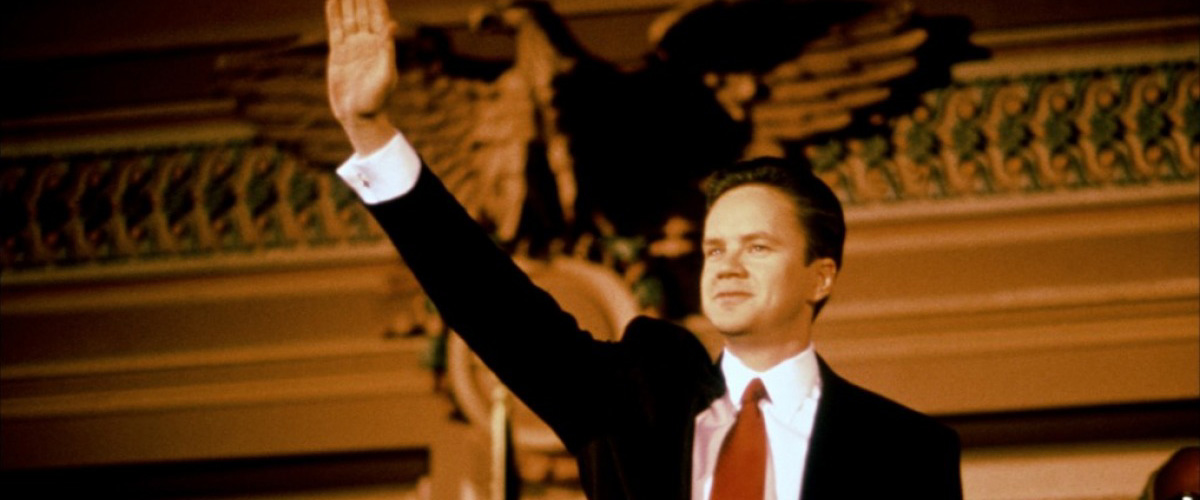
Whatever the case, the film more than merely holds up two decades later. It's relevant, funny, biting and really rather chilling. A wonderful mockumentary detailing the rise and rise of the Wall Street giant turned right wing folk singer (singing horrifying Dylan parodies such as "Times are Changin' Back") turned Senatorial candidate, Bob Roberts.
Masterfully constructed, an almost immaculate example of faking the documentary method, it covers the depths to which he and his team will sink. Their vile tactics and ideals, if indeed they hold the ideals they persistently exude; The film allows itself to be read either way. It has a constant eye on the control they attempt to wield over the perception of their figurehead, and allows, just occasionally for that mask to slip.
It derails slightly towards the finish, as it loses sight of the characters and focuses on the larger political picture. Perhaps a necessary step to cover the sheer scale of the blight Robbins character heralds, but still a shame to find a weak spot in an otherwise flawless film.
I would have been nine at the time of release and so know little of American politics in the era, but I have to wonder if the kind of self serving media savvy demagogue he represents was a political extreme at the time. Whether he was intended as an absurd, monstrous figure, an exaggerated parody rather than the worryingly accurate portrayal of numerous elements of the political field he seems to me today. Maybe it's naive (read: ignorant) of me to assume such image fixated bastards are a relatively new phenomenon.
Whatever the case, the film more than merely holds up two decades later. It's relevant, funny, biting and really rather chilling. A wonderful mockumentary detailing the rise and rise of the Wall Street giant turned right wing folk singer (singing horrifying Dylan parodies such as "Times are Changin' Back") turned Senatorial candidate, Bob Roberts.
Masterfully constructed, an almost immaculate example of faking the documentary method, it covers the depths to which he and his team will sink. Their vile tactics and ideals, if indeed they hold the ideals they persistently exude; The film allows itself to be read either way. It has a constant eye on the control they attempt to wield over the perception of their figurehead, and allows, just occasionally for that mask to slip.
It derails slightly towards the finish, as it loses sight of the characters and focuses on the larger political picture. Perhaps a necessary step to cover the sheer scale of the blight Robbins character heralds, but still a shame to find a weak spot in an otherwise flawless film.
Mad Dog Time
I found myself wondering why I'd never heard of this one, as each new face arrived to reveal an astounding ensemble cast. Richard Dreyfuss, Gabriel Byrne, Jeff Goldblum, Ellen Barkin, Diane Lane, Kyle MacLachlan, Burt Reynolds, Richard Pryor. Richard Pryor! It was either a well hidden treasure or really quite poor. It turned out to be kind of a mix of the two.
It's incredibly odd. Almost a fusion of neo-noir and western, it's little more than a series of armed showdowns that end in one of two ways. It's never really explained, but the gunfights are presented as some sort of game in which people are cordially invited to their own execution. "Fast Draw" Goldblum (perhaps a little miscast as the mobs main gun) either shoots some guy dead at the end of the scene or plays his trump card: he knows where the bosses girl is, and then exits stage left. Each happens three or four times with the apparent aim of killing off everyone in the credits.
The plot could be described in a sentence, everyone is a caricature and it's a bit like watching a Dick Tracy movie that's taking itself a little too seriously, but it does have a few redeeming features. By no means any of the actors finest work, they do all appear to be having a good deal of fun, hamming it up and swanning about in nightclubs carrying guns. Much of the dialogue, especially from Gabriel Byrne, I found incredibly pleasing. It's sharp and poetic, with puns, plays on words and running themes. It's entirely unnatural and makes the whole affair seem very peculiar, almost dreamlike (one character has just been released from the nut house and I began to suspect it was all a fever dream) but it kept me entertained, and redeemed what would otherwise been a shockingly amateurish movie with reasonably high production values.
It reminded my, probably due to a cameo by Joey Bishop (his son being the director) of old Rat Pack movies, that were chaotic affairs that seemed more concerned with their own entertainment than the audiences. They too were slightly tangled, aimless affairs that didn't worry too much about such trivial matters as plot as they had something strong to pull them through, in that case characters in this, dialogue.
It's incredibly odd. Almost a fusion of neo-noir and western, it's little more than a series of armed showdowns that end in one of two ways. It's never really explained, but the gunfights are presented as some sort of game in which people are cordially invited to their own execution. "Fast Draw" Goldblum (perhaps a little miscast as the mobs main gun) either shoots some guy dead at the end of the scene or plays his trump card: he knows where the bosses girl is, and then exits stage left. Each happens three or four times with the apparent aim of killing off everyone in the credits.
The plot could be described in a sentence, everyone is a caricature and it's a bit like watching a Dick Tracy movie that's taking itself a little too seriously, but it does have a few redeeming features. By no means any of the actors finest work, they do all appear to be having a good deal of fun, hamming it up and swanning about in nightclubs carrying guns. Much of the dialogue, especially from Gabriel Byrne, I found incredibly pleasing. It's sharp and poetic, with puns, plays on words and running themes. It's entirely unnatural and makes the whole affair seem very peculiar, almost dreamlike (one character has just been released from the nut house and I began to suspect it was all a fever dream) but it kept me entertained, and redeemed what would otherwise been a shockingly amateurish movie with reasonably high production values.
It reminded my, probably due to a cameo by Joey Bishop (his son being the director) of old Rat Pack movies, that were chaotic affairs that seemed more concerned with their own entertainment than the audiences. They too were slightly tangled, aimless affairs that didn't worry too much about such trivial matters as plot as they had something strong to pull them through, in that case characters in this, dialogue.
Where the Buffalo Roam
While it in no way deserves such treatment I am going to go right ahead and compare this to Fear and Loathing. It has some of the same dialogue and a sprinkling of similar scenes and the primary characters are emulations of the same two people, it was simply impossible not to pit the one against the other. And with Gilliams film being 300 pounds of drug fueled mayhem it's likely Bill Murray will lose some teeth.
If it has one thing over one of the finest films in all creation it's that it more effectively embraced the spirit of "Gonzo". The frenetic stream of consciousness that Hunter S. Thompson sought in his work. Unfortunately it's only really a positive in theory as it amounts to a film that's a structureless mess. A jumbled creaking series of beats with no coherent melody.
The problem with translating his work to the screen is that it's really the beauty of the prose that is the point, the standout scenes in both films are the narration directly from his writing, but while Fear and Loathing built upon this, paralleling it's themes with the action, Where the Buffalo Roam just sort of flounders around it.
Some of the individual scenes are entertaining, and Murray's performance alone is probably worth enduring the remainder. It's a lot closer to how I think of Thompson than Depp's performance, who really exaggerated the extremes. Not that that's in any way a bad thing, indeed it was what that film needed to suit the surrealism, and his vocal inflection was simply sublime, it's just worth mentioning how eerily similar Bill gets to the Hunter I've seen in various documentaries. Peter Boyle as his attorney is another matter, a wonderful actor generally, he's a rounded, gentle man and in no way captures the presence and menace that Del Toro nailed to the wall.
I think it's worth watching for fans of all things Gonzo and for people keen on Fear and Loathing, as it makes strange comparison, but it's little more than a curiosity because as a film it's kind of calamitous.
If it has one thing over one of the finest films in all creation it's that it more effectively embraced the spirit of "Gonzo". The frenetic stream of consciousness that Hunter S. Thompson sought in his work. Unfortunately it's only really a positive in theory as it amounts to a film that's a structureless mess. A jumbled creaking series of beats with no coherent melody.
The problem with translating his work to the screen is that it's really the beauty of the prose that is the point, the standout scenes in both films are the narration directly from his writing, but while Fear and Loathing built upon this, paralleling it's themes with the action, Where the Buffalo Roam just sort of flounders around it.
Some of the individual scenes are entertaining, and Murray's performance alone is probably worth enduring the remainder. It's a lot closer to how I think of Thompson than Depp's performance, who really exaggerated the extremes. Not that that's in any way a bad thing, indeed it was what that film needed to suit the surrealism, and his vocal inflection was simply sublime, it's just worth mentioning how eerily similar Bill gets to the Hunter I've seen in various documentaries. Peter Boyle as his attorney is another matter, a wonderful actor generally, he's a rounded, gentle man and in no way captures the presence and menace that Del Toro nailed to the wall.
I think it's worth watching for fans of all things Gonzo and for people keen on Fear and Loathing, as it makes strange comparison, but it's little more than a curiosity because as a film it's kind of calamitous.
Monday, 23 May 2011
Bad Santa
Telling people about comedies is always problematic. Humour is the very height of subjectivity and is, by some margin the most important metric in determining and discussing their quality, which presents us with something of a quandary. With this firmly in mind, however, Bad Santa is very funny and if you don't think so you are wrong.
Perhaps a little too eager to be tasteless, I found a few of it's jokes falling flat but on the whole they wring a spectacular amount from the wonderfully malevolent character Billy Bob was seemingly born to play. Hapless, hopeless and constantly drunk, he such an excellent character it's almost a shame there isn't more. I was also impressed by the little fat kid, while not a good deal is demanded of him he only once breaks his mask of blissful ignorance and serves as a perfect foil. Almost the ultimate in straight men.
It was inevitably going to be some variation on the Grinch story, but manages to pull it off with little of the usual compromise. He learns just enough to redeem himself whilst still remaining the same glorious wretched bastard. It manages to be sweet without ever actually being saccharine and also at the same time as being massively crass. Quite the feat.
It's packed with smart language, but a dab hand at the visual gags too. At one point he managed to draw an out loud laugh simply by putting on a hat. It rivals Scrooged as my favourite Christmas themed movie, which I think you'll agree is heavy praise.
Perhaps a little too eager to be tasteless, I found a few of it's jokes falling flat but on the whole they wring a spectacular amount from the wonderfully malevolent character Billy Bob was seemingly born to play. Hapless, hopeless and constantly drunk, he such an excellent character it's almost a shame there isn't more. I was also impressed by the little fat kid, while not a good deal is demanded of him he only once breaks his mask of blissful ignorance and serves as a perfect foil. Almost the ultimate in straight men.
It was inevitably going to be some variation on the Grinch story, but manages to pull it off with little of the usual compromise. He learns just enough to redeem himself whilst still remaining the same glorious wretched bastard. It manages to be sweet without ever actually being saccharine and also at the same time as being massively crass. Quite the feat.
It's packed with smart language, but a dab hand at the visual gags too. At one point he managed to draw an out loud laugh simply by putting on a hat. It rivals Scrooged as my favourite Christmas themed movie, which I think you'll agree is heavy praise.
Sunday, 22 May 2011
Tideland
I wanted to like this film. I want to like every Terry Gilliam film so that I can keep referring to him as the most consistently excellent director working today whether it happens to be the case or not. And it does have the beautiful but brutal fantasy feel common to much of his work
But it's a hard film to like. It's a hard film to watch. It doesn't have a plot so much as it's simply spending time with a girl coping with the massively dire circumstances that surround her in the only way that she can: by going batshit crazy.
I'd like to call it daringly unconventional, but frankly I'm just going to go ahead and call it boring. As strong as the little girls performance is (and it is incredibly strong) there's little else to hook you in and drive the film forward. It's just stuff happening, and not very comfortable stuff. It's unrelentingly grim, both her parents die within fifteen minutes and her father sits in the front room and rots. I found little respite in her willful ignorance.
I think if it had been a short film I would be raving about it's wonders instead of focusing largely on the negative. It is beautiful in it's warped way and her fantasy is marvelously understated for Gilliam, but without those threads to follow it's less of a film and more a straight work of art. Magical, distressing, sadly unengaging.
But it's a hard film to like. It's a hard film to watch. It doesn't have a plot so much as it's simply spending time with a girl coping with the massively dire circumstances that surround her in the only way that she can: by going batshit crazy.
I'd like to call it daringly unconventional, but frankly I'm just going to go ahead and call it boring. As strong as the little girls performance is (and it is incredibly strong) there's little else to hook you in and drive the film forward. It's just stuff happening, and not very comfortable stuff. It's unrelentingly grim, both her parents die within fifteen minutes and her father sits in the front room and rots. I found little respite in her willful ignorance.
I think if it had been a short film I would be raving about it's wonders instead of focusing largely on the negative. It is beautiful in it's warped way and her fantasy is marvelously understated for Gilliam, but without those threads to follow it's less of a film and more a straight work of art. Magical, distressing, sadly unengaging.
Saturday, 21 May 2011
Repo Men
I have this strange feeling that I shouldn't like Jude Law, and it's not that I do, but that I don't not. If that makes any sense. Forest Whitaker on the other hand is consistently the bees business in whatever he happens to be in and I will willfully define myself as a fan.
Given this and a personal leaning towards all things sciency and indeed fictiony, I'm not altogether certain why I approached Repo Men gingerly and with the sense that it would be a poor show. It might have been that it's central premise is a Monty Python sketch, or that it managed to make little impact upon release or maybe just because the films marketing managed to avoid giving away any information other than it's stars and concept. Not generally a good sign.
It has a small handful of neat ideas. Call it all kinds of corny but I like the idea that he receives a new heart in both the literal and metaphysical sense, and that he finds a connection with someone who only has a heart left. There's something neatly poetic about that. It also has a vague sense of the William Gibson about it all, and at one point a man is punched by someone dressed as a lung.
Unfortunately this and the presence of the likable Mr. Whitaker really aren't enough. I was actually kind of keen on the character when he was a jolly sociopath, gaining empathy through surgery just makes him boring. The initial setup is done with a good deal of style and a good eye for the humour, but as they reveal the world which he has helped perpetuate it's just all a bit grim and aimless. It lost it's sense of parody, fun and ultimately entertainment.
It also tries to do two things that are hard to do well and fails to do them even reasonably. There's a voice over, which is dry and often clumsy, foraying deep into "explain it to the cheap seats" territory and then there's the twist. Or "twist", as without quotes it rather implies that it intends to trick you in some way, rather than tell you there's a twist up front, slyly wink to the audience and move right along as if they'll kindly forget.
There are also several horrible leaps of logic that bugged me to no end. The absence of any kind of infection, even when engaged in dirty street surgery and the fact that at the end they try to fix their fugitive problem by breaking into corporate headquarters and erasing their files. Because giant, faceless corporations don't keep any kind of backups and wouldn't be suspicious about all the corpses suddenly littering up the place.
Not really actiony enough to satisfy as an action film (which is actually kind of a shame as the action it does have is remarkably well handled) and not really saying enough to do so as a sci fi, it just sort of potters in between with little ambition to be anything more than a middling spring release.
Given this and a personal leaning towards all things sciency and indeed fictiony, I'm not altogether certain why I approached Repo Men gingerly and with the sense that it would be a poor show. It might have been that it's central premise is a Monty Python sketch, or that it managed to make little impact upon release or maybe just because the films marketing managed to avoid giving away any information other than it's stars and concept. Not generally a good sign.
It has a small handful of neat ideas. Call it all kinds of corny but I like the idea that he receives a new heart in both the literal and metaphysical sense, and that he finds a connection with someone who only has a heart left. There's something neatly poetic about that. It also has a vague sense of the William Gibson about it all, and at one point a man is punched by someone dressed as a lung.
Unfortunately this and the presence of the likable Mr. Whitaker really aren't enough. I was actually kind of keen on the character when he was a jolly sociopath, gaining empathy through surgery just makes him boring. The initial setup is done with a good deal of style and a good eye for the humour, but as they reveal the world which he has helped perpetuate it's just all a bit grim and aimless. It lost it's sense of parody, fun and ultimately entertainment.
It also tries to do two things that are hard to do well and fails to do them even reasonably. There's a voice over, which is dry and often clumsy, foraying deep into "explain it to the cheap seats" territory and then there's the twist. Or "twist", as without quotes it rather implies that it intends to trick you in some way, rather than tell you there's a twist up front, slyly wink to the audience and move right along as if they'll kindly forget.
There are also several horrible leaps of logic that bugged me to no end. The absence of any kind of infection, even when engaged in dirty street surgery and the fact that at the end they try to fix their fugitive problem by breaking into corporate headquarters and erasing their files. Because giant, faceless corporations don't keep any kind of backups and wouldn't be suspicious about all the corpses suddenly littering up the place.
Not really actiony enough to satisfy as an action film (which is actually kind of a shame as the action it does have is remarkably well handled) and not really saying enough to do so as a sci fi, it just sort of potters in between with little ambition to be anything more than a middling spring release.
Friday, 20 May 2011
Cobra
A one man army who bucks any and all authority, abominable one liners, montages set to power ballads and a positively reaganesque approach to crime and punishment? Why yes, it's an '80s action movie, starring none other than 'Sly' Stallone himself.
What's brilliant about this particular example, and by brilliant I mean dreadful is that it's unashamedly a political statement. It is quite literally an argument for the death penalty. Several characters go some way out of their way to explain that the only way to stop murders crawling through your window at night is to start lethally injecting some dudes. Or better yet, let the police just gun the suckers down and save on the trial fees.
It is pretty much, and rather ironically Judge Dredd without the irony. Cobra is the law. He carries a gun that is decidedly not standard issue and his superiors aren't mad keen on the way he keeps killing suspects, but what do they know, right? They're just pen pushing desk jockeys and deserve a swift sucker punch, which isn't grounds for dismissal or assault charges or anything.
It really is a movie built upon a single idea about the virtues of harsher law enforcement with random clumps of action movie paraphernalia nailed to it. There's a forgettable car chase and a forgettable shoot out and I think there's a confrontation with the bad guy at some point but I forget. There are flailing attempts at characterisation that probably leaked in from some other films and the chemistry between it's leading man and lady (who fall for one another on the basis that the film needs romance) can only be described as clumsy and awkward, which is funnier when you consider they were married at the time, but then I suppose if you're going to cast the person who happens to be standing closest to you at the time you can't expect miracles. Or acting.
I'm confused by many of it's elements. There are a group of guys at the beginning who are banging axes together, but this is never really elaborated upon. I assume they were the killers gang, but what was the whole gang thing about anyhow? Also, their brilliant plan to avoid being identified by a witness was to confront the police directly. In front of a large numbers of witnesses. Presumably as Judge Cobra took the attractive model out to the sticks to protect the crap out of her, all the people who saw some gigantic crazy looking guy running about a hospital with a knife were being protected by less sociopathic police officers.
It is not, as you might have gathered, one of Stallone's major works, but I think it's fairly representative of the vast majority of eighties action films. In that it's really, really awful.
What's brilliant about this particular example, and by brilliant I mean dreadful is that it's unashamedly a political statement. It is quite literally an argument for the death penalty. Several characters go some way out of their way to explain that the only way to stop murders crawling through your window at night is to start lethally injecting some dudes. Or better yet, let the police just gun the suckers down and save on the trial fees.
It is pretty much, and rather ironically Judge Dredd without the irony. Cobra is the law. He carries a gun that is decidedly not standard issue and his superiors aren't mad keen on the way he keeps killing suspects, but what do they know, right? They're just pen pushing desk jockeys and deserve a swift sucker punch, which isn't grounds for dismissal or assault charges or anything.
It really is a movie built upon a single idea about the virtues of harsher law enforcement with random clumps of action movie paraphernalia nailed to it. There's a forgettable car chase and a forgettable shoot out and I think there's a confrontation with the bad guy at some point but I forget. There are flailing attempts at characterisation that probably leaked in from some other films and the chemistry between it's leading man and lady (who fall for one another on the basis that the film needs romance) can only be described as clumsy and awkward, which is funnier when you consider they were married at the time, but then I suppose if you're going to cast the person who happens to be standing closest to you at the time you can't expect miracles. Or acting.
I'm confused by many of it's elements. There are a group of guys at the beginning who are banging axes together, but this is never really elaborated upon. I assume they were the killers gang, but what was the whole gang thing about anyhow? Also, their brilliant plan to avoid being identified by a witness was to confront the police directly. In front of a large numbers of witnesses. Presumably as Judge Cobra took the attractive model out to the sticks to protect the crap out of her, all the people who saw some gigantic crazy looking guy running about a hospital with a knife were being protected by less sociopathic police officers.
It is not, as you might have gathered, one of Stallone's major works, but I think it's fairly representative of the vast majority of eighties action films. In that it's really, really awful.
The Way Back
The film's story has a rather unusual basis. It was derived from a book that was supposedly a description of a real event, a lengthy escape from a Siberian prison, but it has apparently since been established that it was fiction. So the film finds itself in the odd situation of not dramatising events in order to maintain respect for it's subject and suffering from a lack of characterisation and structure as a result, but without the actual authenticity that would have compensated for both.
It's essentially a lengthy account of how appallingly unpleasant subsistence survival is. One would assume that being the tale of a prison escape there would be a certain amount of tension drawn from the possibility of recapture, but they're only confronted with it once, and briefly. It instead concerns itself with the physical toll of walking a really, really long way with limited food and water.
And it's worth restating that it is largely physical. The characters begin with little depth (the exception being the one guy they left back in camp), and go through little in the way of development. They didn't respond to their plight in a way that made it anything other than a literal journey. Again, I think this is the fault of it's origins, as pure fiction has different rules. I would accept, had these been representing real people, that they had not undergone convenient narrative arcs and it would have changed the viewing to have known that these where the moments of real lives. Perhaps it would be best to have not known the truth going in. So, sorry about that, if you didn't already.
I concede that the tale itself is an interesting one even without external elements. It is beautifully shot and presented and the actors all do a fine job of conveying the hardships, and you do sympathise with the scale of the task that challenges them. I just didn't really see what I was gaining from the experience that would not have been present in a documentary fronted by Ray Mears and covering the similar terrain. Aside from a recipe for salty chicken.
It's essentially a lengthy account of how appallingly unpleasant subsistence survival is. One would assume that being the tale of a prison escape there would be a certain amount of tension drawn from the possibility of recapture, but they're only confronted with it once, and briefly. It instead concerns itself with the physical toll of walking a really, really long way with limited food and water.
And it's worth restating that it is largely physical. The characters begin with little depth (the exception being the one guy they left back in camp), and go through little in the way of development. They didn't respond to their plight in a way that made it anything other than a literal journey. Again, I think this is the fault of it's origins, as pure fiction has different rules. I would accept, had these been representing real people, that they had not undergone convenient narrative arcs and it would have changed the viewing to have known that these where the moments of real lives. Perhaps it would be best to have not known the truth going in. So, sorry about that, if you didn't already.
I concede that the tale itself is an interesting one even without external elements. It is beautifully shot and presented and the actors all do a fine job of conveying the hardships, and you do sympathise with the scale of the task that challenges them. I just didn't really see what I was gaining from the experience that would not have been present in a documentary fronted by Ray Mears and covering the similar terrain. Aside from a recipe for salty chicken.
Thursday, 19 May 2011
Scott Pilgrim vs. the World
We are Sex Bob-Omb! One-two-three-four!
I watched Spaced through recently. Sadly it's not aged very well. Not because it wasn't great, because it was, but because, much like Seinfeld, today we're so familiar with the things that made it special that looking back makes it seem oddly cliché. And worse, those elements, the cutaways, the use of pop culture references, they're almost always used poorly. So I went into Scott Pilgrim with a sizable amount of trepidation. I was worried that even Edgar Wright could not find something fresh in the techniques he'd all but pioneered.
But these fears were unfounded. And how. It instantly establishes the smart, funny, chaotic, musical world in which it takes place. Obviously referential, I imagine there's a risk of excluding some, but isn't that half the fun of the reference? It's laugh out loud funny. The characters are instantly identifiable yet all well formed and engrossing (of special note: his gay roommate Wallace who hogs many of the finer lines. "Watch out! It's that one guy!") and the soundtrack is stonking. It's enormously dense: visual gags, sharp dialogue, references and music all fly fast and indeed furious. It has to move at some pace to contain so much, but it's also surprisingly economical.
It contains just enough, literally the minimum amount of the teenage romance tropes to make the relationship recognisable from similar stories, all while viciously beating those that surround them to death. While not in any way deep itself, it artfully and surprisingly avoids being the kind of shallow romance nonsense we're so often saddled with. I found myself wondering why he should be interested in the apparently troubling girl based purely a dream, but it really doesn't matter. It is all to serve the humour and never to supersede it.
I'm actually annoyed with myself for avoiding it until now. I was seriously concerned that it would be too similar, too trite, too platitudinous (I definitely get thesaurus points for that one) but as it happens there are simply not enough things like Scott Pilgrim in the world. At least there is one.
I watched Spaced through recently. Sadly it's not aged very well. Not because it wasn't great, because it was, but because, much like Seinfeld, today we're so familiar with the things that made it special that looking back makes it seem oddly cliché. And worse, those elements, the cutaways, the use of pop culture references, they're almost always used poorly. So I went into Scott Pilgrim with a sizable amount of trepidation. I was worried that even Edgar Wright could not find something fresh in the techniques he'd all but pioneered.
But these fears were unfounded. And how. It instantly establishes the smart, funny, chaotic, musical world in which it takes place. Obviously referential, I imagine there's a risk of excluding some, but isn't that half the fun of the reference? It's laugh out loud funny. The characters are instantly identifiable yet all well formed and engrossing (of special note: his gay roommate Wallace who hogs many of the finer lines. "Watch out! It's that one guy!") and the soundtrack is stonking. It's enormously dense: visual gags, sharp dialogue, references and music all fly fast and indeed furious. It has to move at some pace to contain so much, but it's also surprisingly economical.
It contains just enough, literally the minimum amount of the teenage romance tropes to make the relationship recognisable from similar stories, all while viciously beating those that surround them to death. While not in any way deep itself, it artfully and surprisingly avoids being the kind of shallow romance nonsense we're so often saddled with. I found myself wondering why he should be interested in the apparently troubling girl based purely a dream, but it really doesn't matter. It is all to serve the humour and never to supersede it.
I'm actually annoyed with myself for avoiding it until now. I was seriously concerned that it would be too similar, too trite, too platitudinous (I definitely get thesaurus points for that one) but as it happens there are simply not enough things like Scott Pilgrim in the world. At least there is one.
Bronson
It's funny how jovial psychopaths often make excellent storytellers. At least they do at a safe distance. I'm not sure you would want to actually be in the car when they told the story of that magical evening they repeatedly stabbed a police officer. "We was larfin'."
Bronson is a maniacal portrait of a man incredibly proud of his status as the most violent prisoner in Britain. Tom Hardy is spectacular as the clearly deranged but disarmingly charming beast of a man. Blending comedy and menace and never shying away from what was clearly a very demanding role, involving reshaping his entire body and a good deal of full frontal nudity. Bronson was keen on going into battle butt naked and greased, you see.
While engaging and capable of occasional genius, it does feel like terribly familiar ground. It does have it's own take upon things but it's hard not to think of it as Chopper with different facial hair. Which isn't such a bad thing, it is after all a particularly fine 'tache. It's just that it fell, seemingly inevitably into the traps laid out for it by so many prison dramas and biographies.
The first half, narrated by Bronson himself is fast paced, arresting (if you'll forgive the pun) and often hilarious, but, as is so often the case, it all goes a bit pear shaped once he leaves Her Majesties considerable pleasure. We discover that the initial farce is a counterpoint to the grim aimlessness of his existence. It doesn't try to impose reason to his actions or labour any particular point, but it begins to paint him as an essentially ludicrous figure. A victim of his own outlandish persona.
A perfectly valid point to make, and one I felt well made, but I couldn't help but miss the anarchic storyteller from the films beginning, with a grin on his face and a violent glint in his eye.
Bronson is a maniacal portrait of a man incredibly proud of his status as the most violent prisoner in Britain. Tom Hardy is spectacular as the clearly deranged but disarmingly charming beast of a man. Blending comedy and menace and never shying away from what was clearly a very demanding role, involving reshaping his entire body and a good deal of full frontal nudity. Bronson was keen on going into battle butt naked and greased, you see.
While engaging and capable of occasional genius, it does feel like terribly familiar ground. It does have it's own take upon things but it's hard not to think of it as Chopper with different facial hair. Which isn't such a bad thing, it is after all a particularly fine 'tache. It's just that it fell, seemingly inevitably into the traps laid out for it by so many prison dramas and biographies.
The first half, narrated by Bronson himself is fast paced, arresting (if you'll forgive the pun) and often hilarious, but, as is so often the case, it all goes a bit pear shaped once he leaves Her Majesties considerable pleasure. We discover that the initial farce is a counterpoint to the grim aimlessness of his existence. It doesn't try to impose reason to his actions or labour any particular point, but it begins to paint him as an essentially ludicrous figure. A victim of his own outlandish persona.
A perfectly valid point to make, and one I felt well made, but I couldn't help but miss the anarchic storyteller from the films beginning, with a grin on his face and a violent glint in his eye.
Wednesday, 18 May 2011
Contact
You would not think frustration was a good thing to derive from a film, that gratification would be where "it" is "at" and that leaving one mildly peeved would be a major point of criticism. But I've spent all day trying to understand precisely why Contact left me less than satisfied and have come to the alarming conclusion that it has as much to do with myself as it has the content of the film.
You see, it's not really a film about aliens, but rather about faith. About how the divide between science and religion is artificial, that modernity and meaning do not necessarily need to be in conflict. While I wanted it to be about freaking aliens.
The momentum prior to the leap into the unknown is positively joyous, as fresh discoveries and victories lead to a single fascinating point, but it ends as an incredibly personal journey for Jodie Foster's character (who gave, incidentally, an excellent performance as the errant, obsessive astronomer). The "message" she brings back to earth is reliant upon faith, which for me felt like failure, a straightforward lack of resolution. I felt empathy for the science itself, that in that position I would need to be proven, personal faith would never be enough. I place little faith in it.
I was also distressed by the fact that there clearly was evidence: the crazy energy from the machine and the initial confirmation of Vega, which a satellite could never fake, not to mention the on board instrumentation. More testing was clearly required.
It was also a little heavy handed in places, despite surprising subtlety in others. There is the odd air of the pantomime villain about a few of the people she comes into conflict with, and I think such individual pettiness is too easily dismissed.
But nevertheless, I did spend all that time thinking about it and how I personally related to it was an important part of the experience. I consider these hallmarks of potent science fiction, indications of it's success, and which are far rarer than they should be. I was left feeling that the absence of a conclusion was the very point, that being neatly wrapped would have been at odds with it's discussion on belief, that my frustration was actively the intent. And I can't honestly say that that was a bad thing.
You see, it's not really a film about aliens, but rather about faith. About how the divide between science and religion is artificial, that modernity and meaning do not necessarily need to be in conflict. While I wanted it to be about freaking aliens.
The momentum prior to the leap into the unknown is positively joyous, as fresh discoveries and victories lead to a single fascinating point, but it ends as an incredibly personal journey for Jodie Foster's character (who gave, incidentally, an excellent performance as the errant, obsessive astronomer). The "message" she brings back to earth is reliant upon faith, which for me felt like failure, a straightforward lack of resolution. I felt empathy for the science itself, that in that position I would need to be proven, personal faith would never be enough. I place little faith in it.
I was also distressed by the fact that there clearly was evidence: the crazy energy from the machine and the initial confirmation of Vega, which a satellite could never fake, not to mention the on board instrumentation. More testing was clearly required.
It was also a little heavy handed in places, despite surprising subtlety in others. There is the odd air of the pantomime villain about a few of the people she comes into conflict with, and I think such individual pettiness is too easily dismissed.
But nevertheless, I did spend all that time thinking about it and how I personally related to it was an important part of the experience. I consider these hallmarks of potent science fiction, indications of it's success, and which are far rarer than they should be. I was left feeling that the absence of a conclusion was the very point, that being neatly wrapped would have been at odds with it's discussion on belief, that my frustration was actively the intent. And I can't honestly say that that was a bad thing.
Tuesday, 17 May 2011
Equilibrium
Bale gives a typically intense performance as a man who's supposed to be devoid of emotion, yet emotes like it's been illegal for some time and is suddenly just discovering it. Fortunately this isn't a contradiction as it happens to be the case.
It is the job of the (oddly vindictive and gleefully zealous for purely logical folk) Grammaton Clerics to discover and root out those who refuse to medically suppress emotion. One can only assume that they do not get a lot of practice, as Bale, being a Cleric himself is surrounded by them daily, expressing like a man on fire. You can sort of see the problem they had here: "How do we portray convincing conflict between characters when none of them have emotions?", the films makers no doubt said to themselves. "Lets just pretend they don't when they do" was apparently the response.
Quite aside from this problem, the premise isn't really used to say anything about the nature of emotion or humanity, it's just used as the stick the central authority uses on the populous, a crime for which they clearly must be punished. It's not very satisfying sci fi. It's not especially strong action either. While the fictional "Gun Kata" martial art was an interesting (if silly) idea, and there are several good sequences (that inevitably compare unfavourably to The Matrix), it's all ever so slightly too stylised, the precision of the Kata making it all cold and mechanical and heartless.
I get the distinct impression that it is a film attempting to serve two masters and neither can be especially happy with the service. It's a sloppy but curious action film and by Hollywood standards a reasonable attempt at fairly high concept science fiction. It's just unfortunate that that's such a low bar.
It is the job of the (oddly vindictive and gleefully zealous for purely logical folk) Grammaton Clerics to discover and root out those who refuse to medically suppress emotion. One can only assume that they do not get a lot of practice, as Bale, being a Cleric himself is surrounded by them daily, expressing like a man on fire. You can sort of see the problem they had here: "How do we portray convincing conflict between characters when none of them have emotions?", the films makers no doubt said to themselves. "Lets just pretend they don't when they do" was apparently the response.
Quite aside from this problem, the premise isn't really used to say anything about the nature of emotion or humanity, it's just used as the stick the central authority uses on the populous, a crime for which they clearly must be punished. It's not very satisfying sci fi. It's not especially strong action either. While the fictional "Gun Kata" martial art was an interesting (if silly) idea, and there are several good sequences (that inevitably compare unfavourably to The Matrix), it's all ever so slightly too stylised, the precision of the Kata making it all cold and mechanical and heartless.
I get the distinct impression that it is a film attempting to serve two masters and neither can be especially happy with the service. It's a sloppy but curious action film and by Hollywood standards a reasonable attempt at fairly high concept science fiction. It's just unfortunate that that's such a low bar.
Monday, 16 May 2011
Crank
An action movie with an original idea. Who on gods green earth would have thunk it.
After thirty seconds of exposition in which we're told our unlucky protagonist has been fatally poisoned and has less than an hour to live, he promptly trashes the room and starts running. Starts running and does not stop. Adrenaline is literally keeping him alive and so Jason Statham and the film itself charge headlong toward his target, keeping a frantic drug fueled pace in the hopes of returning the fatal favour before his time is up.
It's quite wonderful at first. Pretenses are dispensed with in favour of multiple barrels of fun. Right from the start it crashes non stop from scene to scene with a healthy mix of outlandish action, a little light body horror and well placed farce.
And then it all goes a little astray. You see, he has a girlfriend. This isn't bad in and of itself, indeed there are certain merits to the presence of Amy Smart in various states of undress, but her arrival in the film heralds a small swathe of action movie clichés and even worse, brings the pace crashing back to earth.
We discover that for love of her our hero is an Assassin On One Last Job, and he must protect her from the forces that surround him whilst keeping his dual life secret. Once she does discover the uncomfortable truth she does add a new, interesting and perhaps needed dynamic to the whole adrenalin run thing, but keeping the details of his day from her necessitates the film slow to a relative crawl, a gear change from which it never really recovers. It finds it's feet occasionally, but it changes from gloriously breakneck to sadly sporadic.
It's not a lethal blow, it's still solid and lively action fare, but I can't help but feel there was a magnificent idea that wasn't quite allowed to ripen. That it's forty minutes of gold weighed down by a further forty of slightly less precious metals.
After thirty seconds of exposition in which we're told our unlucky protagonist has been fatally poisoned and has less than an hour to live, he promptly trashes the room and starts running. Starts running and does not stop. Adrenaline is literally keeping him alive and so Jason Statham and the film itself charge headlong toward his target, keeping a frantic drug fueled pace in the hopes of returning the fatal favour before his time is up.
It's quite wonderful at first. Pretenses are dispensed with in favour of multiple barrels of fun. Right from the start it crashes non stop from scene to scene with a healthy mix of outlandish action, a little light body horror and well placed farce.
And then it all goes a little astray. You see, he has a girlfriend. This isn't bad in and of itself, indeed there are certain merits to the presence of Amy Smart in various states of undress, but her arrival in the film heralds a small swathe of action movie clichés and even worse, brings the pace crashing back to earth.
We discover that for love of her our hero is an Assassin On One Last Job, and he must protect her from the forces that surround him whilst keeping his dual life secret. Once she does discover the uncomfortable truth she does add a new, interesting and perhaps needed dynamic to the whole adrenalin run thing, but keeping the details of his day from her necessitates the film slow to a relative crawl, a gear change from which it never really recovers. It finds it's feet occasionally, but it changes from gloriously breakneck to sadly sporadic.
It's not a lethal blow, it's still solid and lively action fare, but I can't help but feel there was a magnificent idea that wasn't quite allowed to ripen. That it's forty minutes of gold weighed down by a further forty of slightly less precious metals.
Sunday, 15 May 2011
Priest
If Legion snuck away from the cinema and returned sporting a new hat and maybe a false beard, the result would be much like Priest. But almost certainly funnier.
I've no idea why they feel the need to keep making these films so goddamn serious. Even the subtlest of knowing nods, winks or cap doffs to the fact that it's purely popcorn affair would have raised it above "complete nonsense". Not a great deal above, but still.
In a bid to truly corner the market in glowering religious types, Paul Bettany finds himself in a film about ninja-cowboy-steampunk-priests, and instead of the movie accepting that it's clearly going to be very daft and having some gosh-darn fun, they all scowl through dialogue apparently written by hobos paid with food, doing their worst Clint Eastwood impressions. A string of snappy one liners is consistently delivered without a single trace of snap and horrible analogies are made to Vietnam veterans.
The film wields it's essential features with all the art and grace of a drunk with a kebab. The religious element, critical one might think to the whole priest thing, exists purely as a general autocracy with some eccentricities so as to avoid any kind of point, the science fiction elements are copied and pasted entirely from Judge Dredd, the western ones are all cliches that have been outdated for decades and so keen is it that it's vampires are different that they're not really vampires at all, rather random sun fearing monsters, which wouldn't be a problem, except that the Big Reveal at the end (which they actually bother to set up with a series of previous hooks) is that Hatty McGruff, the villain of the piece, turns out to be an ordinary stinking vampire, which we'd all guessed from the fact that he was a vampire, but the characters have never seen before and the film goes right ahead and assumes the audience haven't either. If a film is going to insult my intellect right to my face, it should least have the common decency to do so sneakily and behind my back.
The outlandish, anime style combat (which it explains are the result of "powers", which are never elaborated on) and relatively impressive monster based action might be satisfying for those in the mood for such things, but honestly the only thing Priest put me in the mood for was not watching Priest.
The long and the short is that Scott Charles Stewart is not a director, he's a visual effects "guy". He's the kind of person you bring in if the producers knocked together the script from a bunch of cliches they felt would sell and roped in a writer (or the aforementioned vagrants) to fill in the gaps. They weren't after a strong movie, or even an especially successful one, they wanted to wing it all together with as little fuss as feasible and grab some of those precious international market readies.
I've no idea why they feel the need to keep making these films so goddamn serious. Even the subtlest of knowing nods, winks or cap doffs to the fact that it's purely popcorn affair would have raised it above "complete nonsense". Not a great deal above, but still.
In a bid to truly corner the market in glowering religious types, Paul Bettany finds himself in a film about ninja-cowboy-steampunk-priests, and instead of the movie accepting that it's clearly going to be very daft and having some gosh-darn fun, they all scowl through dialogue apparently written by hobos paid with food, doing their worst Clint Eastwood impressions. A string of snappy one liners is consistently delivered without a single trace of snap and horrible analogies are made to Vietnam veterans.
The film wields it's essential features with all the art and grace of a drunk with a kebab. The religious element, critical one might think to the whole priest thing, exists purely as a general autocracy with some eccentricities so as to avoid any kind of point, the science fiction elements are copied and pasted entirely from Judge Dredd, the western ones are all cliches that have been outdated for decades and so keen is it that it's vampires are different that they're not really vampires at all, rather random sun fearing monsters, which wouldn't be a problem, except that the Big Reveal at the end (which they actually bother to set up with a series of previous hooks) is that Hatty McGruff, the villain of the piece, turns out to be an ordinary stinking vampire, which we'd all guessed from the fact that he was a vampire, but the characters have never seen before and the film goes right ahead and assumes the audience haven't either. If a film is going to insult my intellect right to my face, it should least have the common decency to do so sneakily and behind my back.
The outlandish, anime style combat (which it explains are the result of "powers", which are never elaborated on) and relatively impressive monster based action might be satisfying for those in the mood for such things, but honestly the only thing Priest put me in the mood for was not watching Priest.
The long and the short is that Scott Charles Stewart is not a director, he's a visual effects "guy". He's the kind of person you bring in if the producers knocked together the script from a bunch of cliches they felt would sell and roped in a writer (or the aforementioned vagrants) to fill in the gaps. They weren't after a strong movie, or even an especially successful one, they wanted to wing it all together with as little fuss as feasible and grab some of those precious international market readies.
Subscribe to:
Comments (Atom)